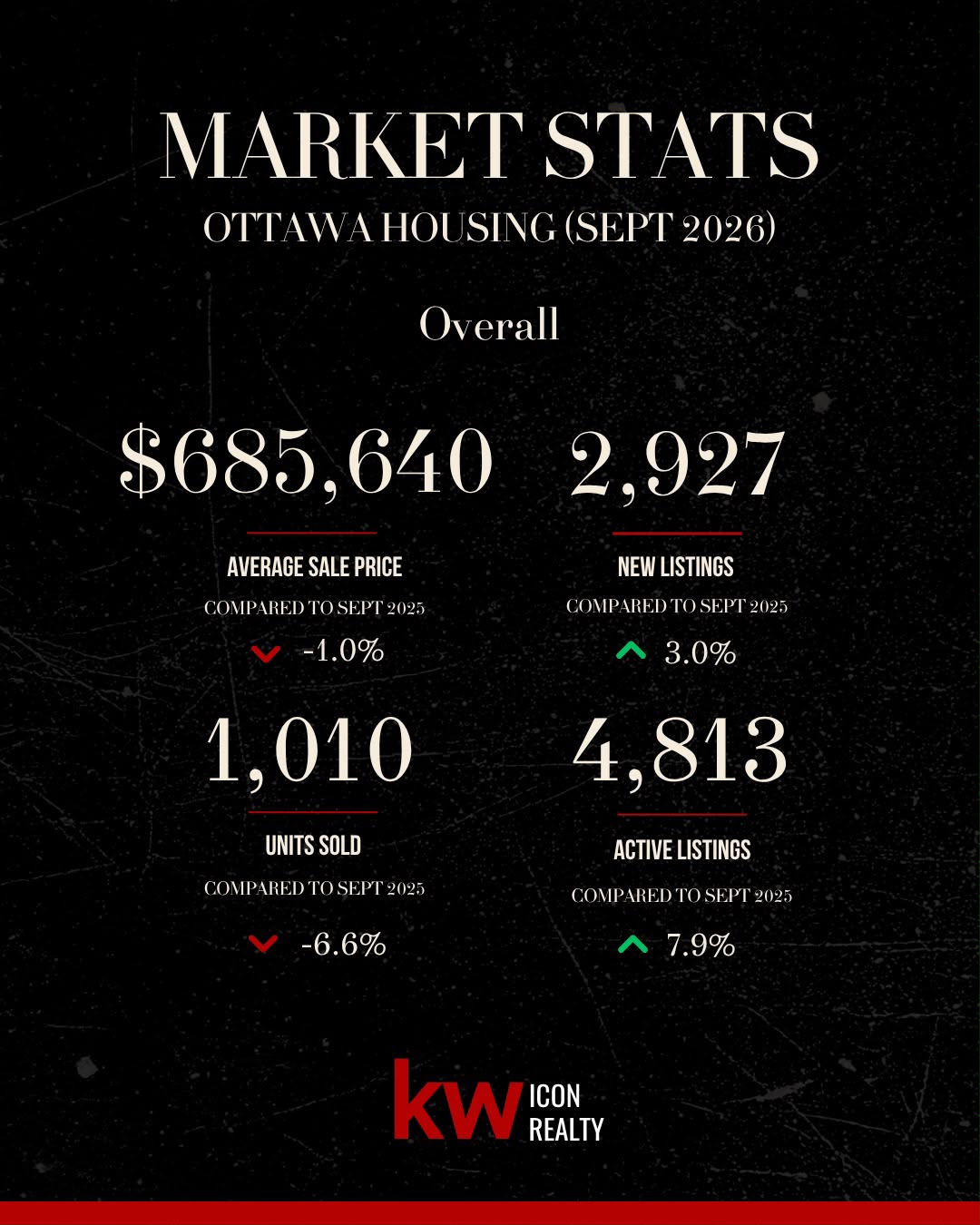
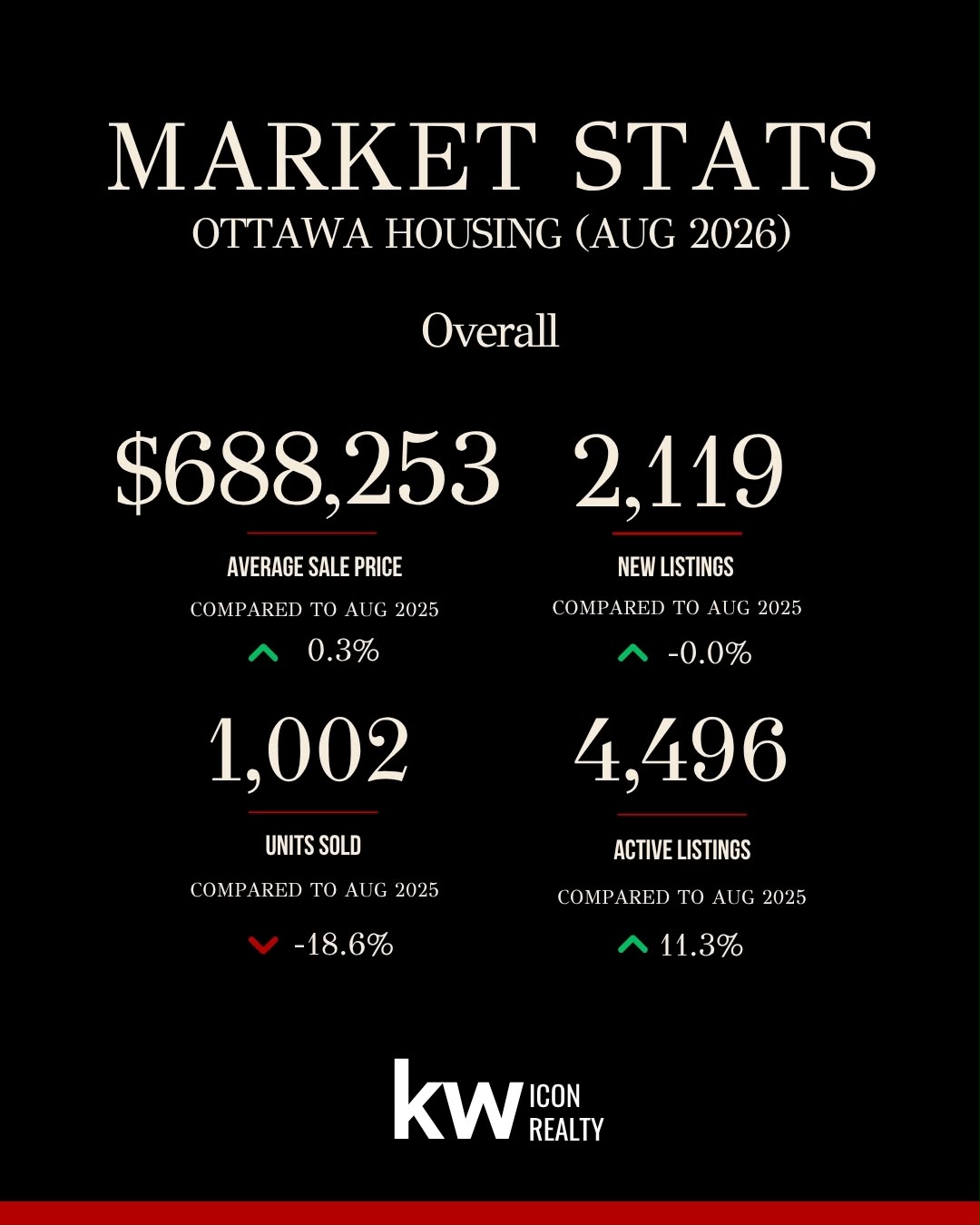
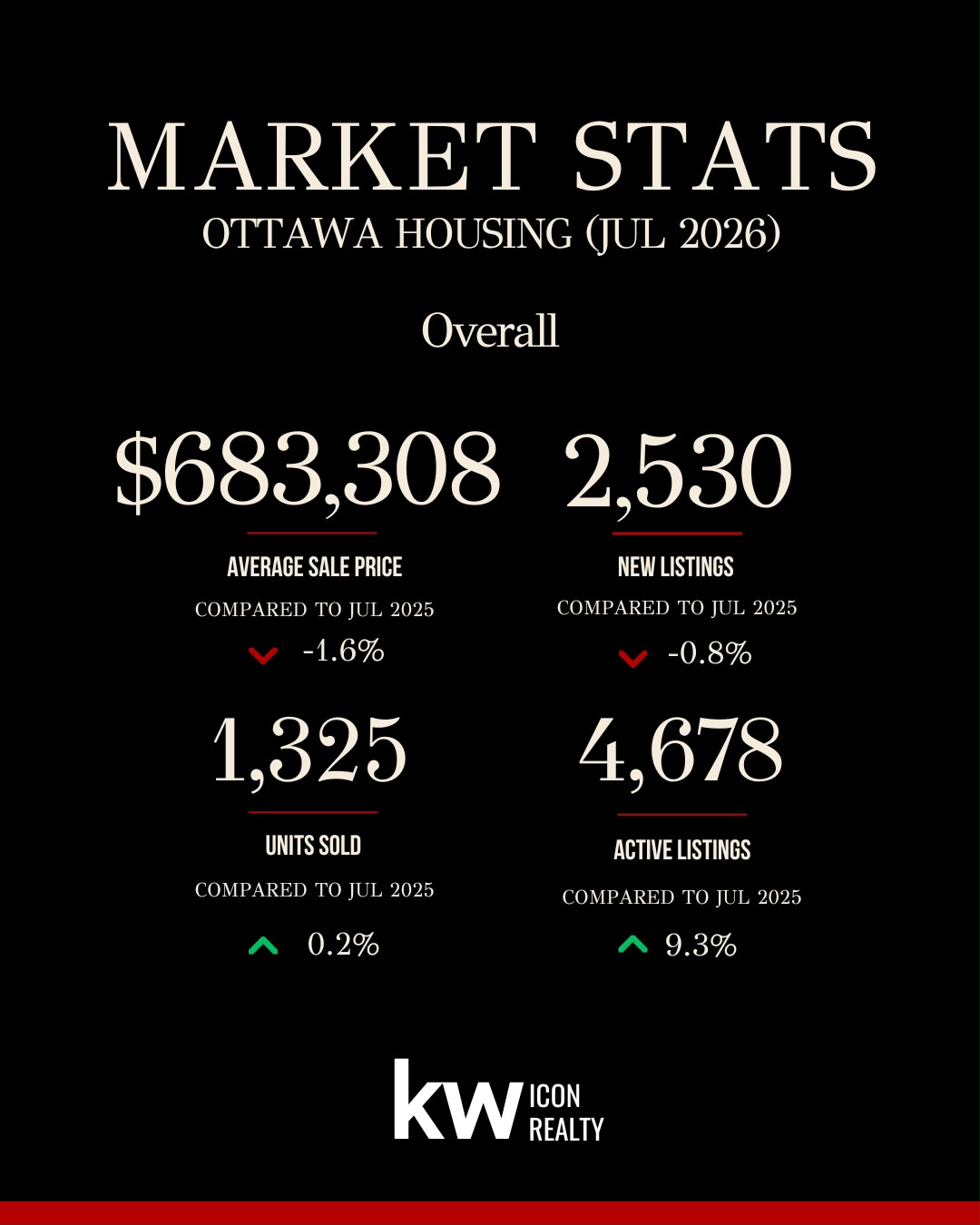
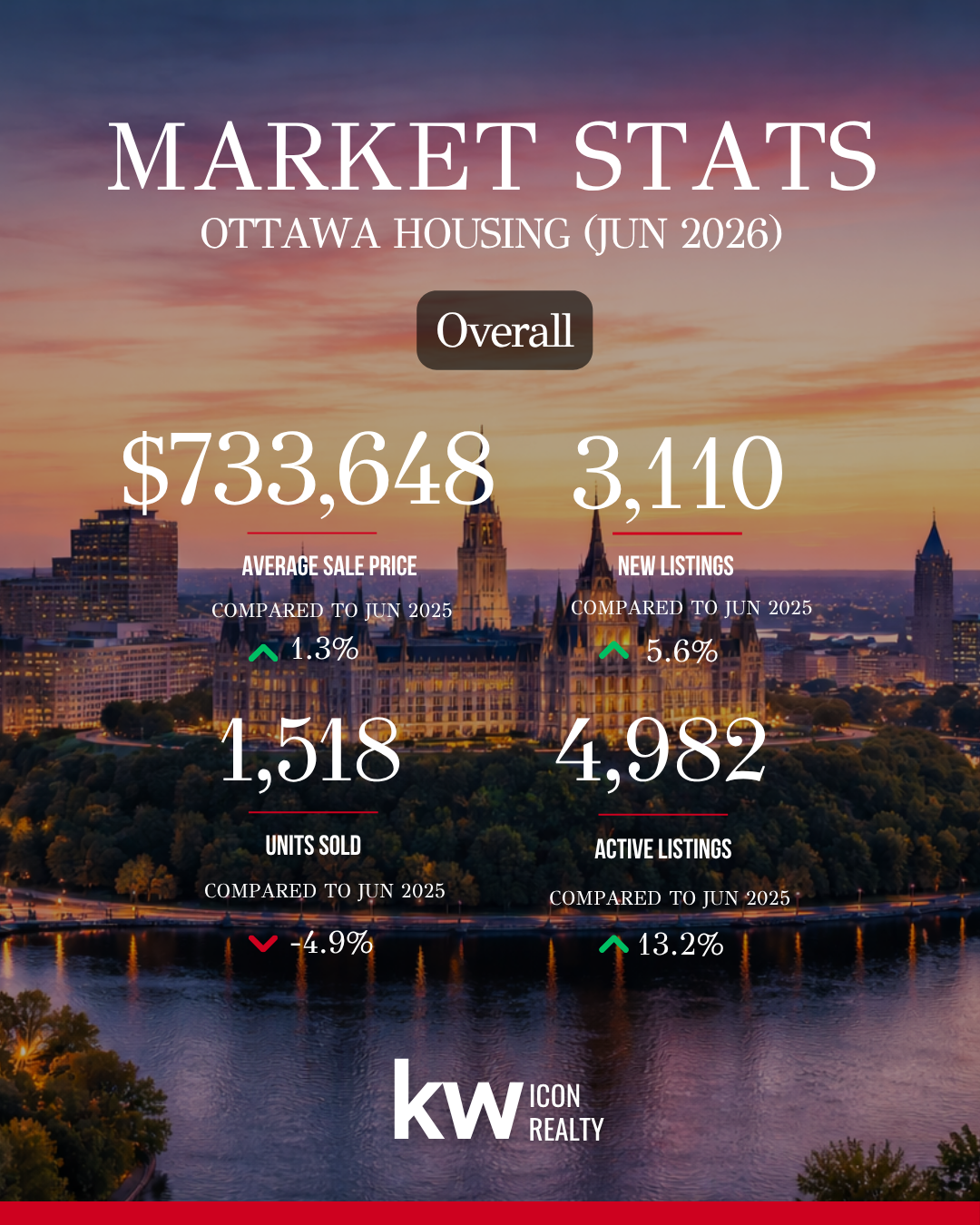
Ottawa Real Estate Market Update

In the fast-paced Ottawa real estate market, knowledge isn't just power—it's your strategic advantage. Understanding the latest trends in sales, pricing, and inventory is the first step toward making an empowered decision, whether you're planning to buy, sell, or invest. Here is our expert breakdown of the key data you need to know for.

RSS

OTTAWA REAL ESTATE-MAY STATS (2026)

Seasonal Activity Improves, but Ottawa’s May Market Remains Cautious

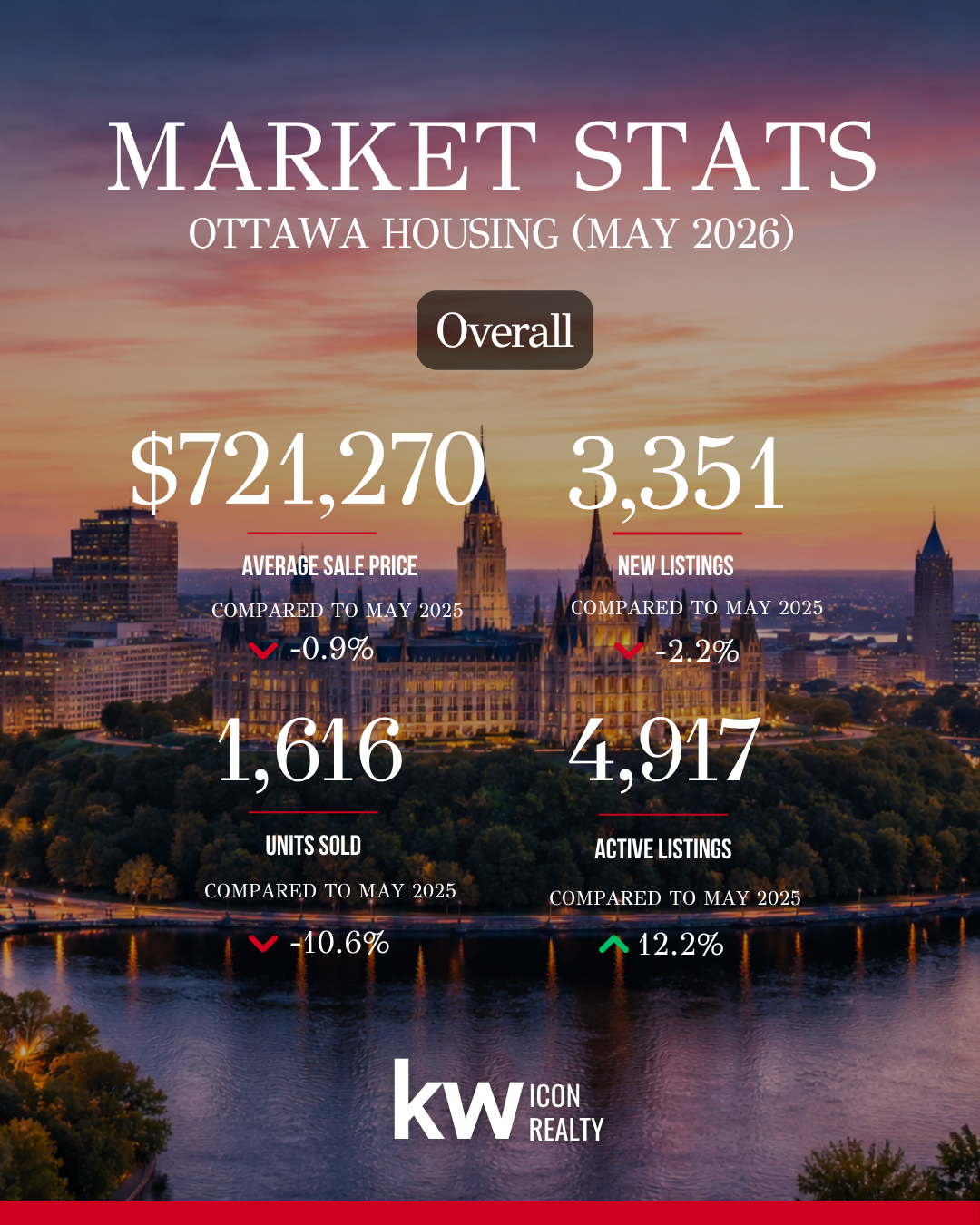
Ottawa’s housing market remained balanced in May, with activity improving from April but continuing to trail last year’s spring pace. A total of 1,616 homes sold in May, up from 1,336 in April, reflecting the typical lift as the spring market progressed. However, sales were down 10.6% compared to May 2025. These slower sales are becoming a theme thus far in 2026, even as the market remains active.

The sales-to-new-listings ratio rose to 48.2%, while months of inventory eased to 3.0, indicating demand kept better pace with new supply than it did in April. Active listings remained elevated at 4,917, keeping pressure on sellers to price strategically.

Average prices across market segments were mixed, though overall pricing remained relatively stable. Single-family home pricing was flat year over year, while average prices for townhomes and apartments saw modest declines. Overall pricing was less than one percentage point below last year’s level, indicating continued market stability. The average residential sale price was $721,270 in May, up from $712,184 in April, and relatively flat at 0.9% below May 2025. The median sale price followed a similar pattern, rising to $660,000 from $650,000 in April while remaining 1.6% lower than last May.

Performance varied by property type. Single-family homes remained resilient, with average prices essentially unchanged year over year and the median price up 1.3%. Townhomes and apartment-style properties continued to face softer conditions, with both average and median prices below last year’s levels.

The MLS® Home Price Index (HPI) composite benchmark price increased 0.9% from April but remained 0.6% below May 2025, reflecting continued variation across market segments.

Economic uncertainty continues to influence market activity. Recent GDP data has fueled discussion about Canada’s economic momentum, while the Bank of Canada has continued to take a cautious approach to interest rates. CMHC data reported lower employment levels in the first quarter compared to a year earlier, while CREA’s labour-market charts point to stronger full-time job growth and an unemployment rate that has eased from its early-2026 peak.

Ottawa’s market remains balanced, but the data also points to clear challenges. Sales continue to lag last year’s pace, inventory is elevated, and softer segments are weighing on the broader price picture. The strength of the summer market will depend on whether demand continues to absorb supply at a steady pace.

“The Ottawa market is not moving in one direction across all property types,” says OREB President Tami Eades. “May brought the seasonal increase in activity we typically expect to see in Ottawa’s housing market, but sales continue to trail last year’s pace. While economic uncertainty continues to influence consumer confidence, the key question moving into the summer market will be whether demand continues to keep pace with supply. The market remains active, but inventory levels, employment trends, and buyer confidence will all play an important role in shaping the months ahead.”

Residential Market Activity

In May, 1,616 homes were sold through the MLS® System in Ottawa, a 10.6% decrease compared to May 2025, but a clear increase from 1,336 sales in April. The month-over-month gain reflects the typical spring lift in activity, even as demand continues to trail last year’s stronger spring pace.

Sales activity was down in May compared to 2025, though the extent of that decline varied by property type. Single-family homes recorded 904 sales in May, down 8.6% from a year earlier. Townhouse sales totalled 481, down 14.3%, while apartment-style properties recorded 203 sales, down 12.1%. The segment-level results point to a market where demand remains present, but activity is trailing 2025 across all segments.

Supply remained elevated. New listings totalled 3,351 in May, down 2.2% from May 2025, while active listings rose to 4,917 units, up 12.2% year over year and above April’s 4,535 listings. While new listings did not surge this month, the elevated level of active inventory shows that supply has continued to accumulate.

The sales-to-new-listings ratio improved to 48.2%, up from 41.0% in April and consistent with balanced market conditions.

Year to date, 5,453 homes have sold in Ottawa, down 6.3% from the same period in 2025. New listings total 12,284, up 5.4%, while average active listings are up 14.8%. The year-to-date sales-to-new-listings ratio of 44.4% and 3.5 months of inventory point to a market that remains balanced overall, but one where sellers face more competition than they did last spring.

Prices and Market Balance

Price trends remained stable in May, but they were not uniform across property types. The average residential sale price in May was $721,270, down 0.9% from May 2025 but up from $712,184 in April. The median price was $660,000, down 1.6% year over year and up from $650,000 in April. Year to date, the average price is $694,539, down 0.6%, while the median price is $639,000, down 1.7%.

Single-family homes remained the most resilient segment, with an HPI benchmark price of $723,800, up 0.9% from April and 0.3% year over year. The average single-family sale price was essentially unchanged from last May, while the median price rose 1.3% to $800,000.

The townhome segment softened in May data compared to recent months. Earlier in the year, townhome activity was holding up comparatively well, but May reversed that pattern. Townhouse sales fell 14.3% year over year, pulling year-to-date sales 2.8% below 2025. Pricing has not fallen sharply month over month, with the townhouse HPI benchmark at $557,500, down 0.4% from April and 3.2% from last May. The larger signal is softer absorption, as active listings remain elevated and months of inventory sit well above last year’s level.

Apartment-style properties continued to show the most pronounced pressure. The apartment benchmark price was $385,500, up 1.5% from April but down 6.7% from May 2025. Average and median apartment prices were also lower year over year. This weakness is not unique to Ottawa; Toronto’s condo sector has also been affected by weaker investor demand and higher carrying costs. Ottawa’s apartment segment, however, should still be understood within local conditions: the data points to a slower, more price-sensitive segment, not a broad market correction.

Months of Inventory:

  • Single-Family: 2.7

  • Townhome: 2.7

  • Apartment: 4.8

Ottawa is not experiencing broad-based price growth, but neither is the market showing a uniform decline in price. Single-family homes continue to provide support, townhomes are adjusting, and apartment-style properties remain the softest part of the market. For sellers, accurate pricing remains critical; for buyers, the data points to a market where patience and property-specific analysis matter more than broad assumptions about Ottawa as a whole.

Regional Market Comparison

Ottawa’s regional picture was uneven in May, reinforcing that the citywide market is not moving as one single market. The central market and Ottawa Rural West were the only subareas to record year-over-year sales gains, while the suburban areas continued to drive most of the overall activity.

Ottawa Centre had the clearest positive activity signal, with sales up 13.5% from May 2025 and prices also higher year over year. This suggests stronger engagement in the central market after a softer start to the year, though the area’s varied property mix means monthly price movements should be interpreted with some caution.

The suburban markets remained the core of Ottawa’s sales activity, but the story differed by area. Ottawa Suburb West recorded the highest sales total and the lowest months of inventory, pointing to relatively stronger absorption. However, prices were lower than last May, so its strength was more about activity than price growth. Ottawa Suburb South remained steady but softer than last year, while Ottawa Suburb East saw a sharper decline in sales even as prices moved higher.

Rural markets were more variable, which is typical given smaller transaction volumes. Ottawa Rural West was the relative bright spot, with sales slightly above last May, while Ottawa Rural East and Rural South both recorded weaker activity. Rural East also had the highest inventory level among the subareas, pointing to slower absorption.

Overall, the regional data points to a market shaped by local differences rather than one broad trend. Central Ottawa improved in May, the west remained active, and rural conditions were more uneven. For buyers and sellers, neighbourhood, property type, and local competition continue to matter more than the citywide averages alone. Detailed regional tables are available in the non-HPI report included in the monthly stats package.

Looking Ahead

As Ottawa moves into the summer market, the most useful signals will come less from broad forecasts and more from whether demand continues to absorb supply at a steady pace. REALTORS® should be watching the sales-to-new-listings ratio, months of inventory by property type, median days on market, sale-to-list ratios, and whether benchmark prices continue to diverge between single-family, townhouse, and apartment-style properties.

CMHC’s latest construction data adds important context. Housing starts were lower year over year across all dwelling types in April, but the pipeline is shifting in composition. Rental projects accounted for 61% of starts by market type, while apartments made up most new starts and the large majority of units currently under construction. That changing mix will matter most for apartment-style resale pricing, investor demand, and rental-market competition as projects move toward completion.

Completed and unabsorbed inventory should also be monitored closely. CMHC’s April data shows this inventory has risen, with the largest concentration in row and single-detached homes. For REALTORS®, absorption of newly completed units will be an important companion indicator to resale inventory, especially in segments where pricing has already become more sensitive.

Taken together, the indicators to watch are clear: resale inventory, new listings, absorption of completed new homes, the apartment-heavy construction pipeline, and local employment conditions. These will offer a better read on Ottawa’s next phase than any single month of sales or pricing data alone.

(SOURCE: OREB)

Read

OTTAWA REAL ESTATE - APRIL STATS (2025)

Momentum Builds in Ottawa’s Housing Market Amid Greater Certainty

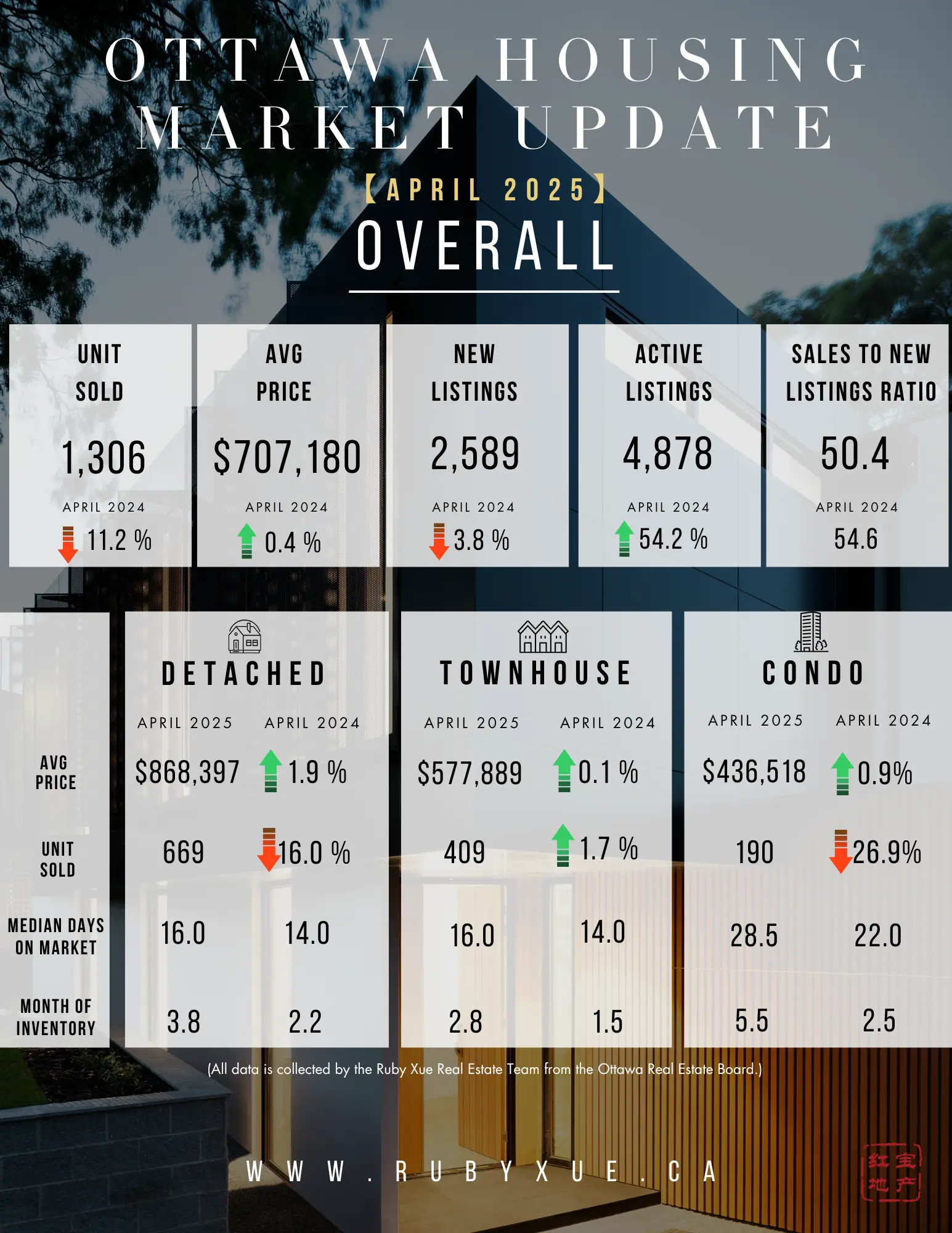
The number of homes sold through the MLS® System of the Ottawa Real Estate Board (OREB) totaled 1,306 units in April 2025. This represented an 18.4% increase from March 2025, but an 11.2% decline from April 2024.

Home sales were 17.6% below the five-year average and 16.2% below the 10-year average for the month of April.

“While April sales were down year-over-year, we saw a healthy month-over-month increase—an encouraging sign of growing momentum as we move through the spring market,” says OREB President Paul Czan. “Inventory remains at higher levels compared to previous years, indicating a gradual move towards a balanced market.”

“With more certainty following the federal election, buyers are returning with greater confidence—but they’re proceeding cautiously, taking their time, including conditions in their offers, and being more selective,” adds Czan. “Sellers, meanwhile, are adjusting to longer days on market, which makes strategic pricing and thoughtful home preparation more important than ever. If the listing is priced well, shows well, it’s moving—possibly getting multiple offers. Looking ahead, we’ll be watching how the federal government’s recent housing commitments translate into action. Policies aimed at increasing supply, improving affordability, and supporting first-time buyers are welcome steps toward meaningful impact here in Ottawa.”

By the Numbers – Prices:

  • The overall MLS® HPI composite benchmark price was $631,200 in April 2025, a 1.1% rise compared to April 2024.

    • The benchmark price for single-family homes was $703,200, up 1.0% year-over-year in April.

    • By comparison, the benchmark price for a townhouse/row unit was $440,000, an increase of 4.4% from 2024.

    • The benchmark apartment price was $404,000, a 2.8% decline from the previous year.

  • The average price of homes sold in April 2025 was $707,180, a 0.4% increase from April 2024.

  • The total dollar volume of all home sales in April 2025 amounted to $923.5 million, a 10.8% drop compared to the same period last year.

OREB cautions that the average sale price can be useful in establishing trends over time but should not be used as an indicator that specific properties have increased or decreased in value. The calculation of the average sale price is based on the total dollar volume of all properties sold. Prices will vary from neighbourhood to neighbourhood.

By the Numbers – Inventory & New Listings:

  • The number of new listings declined by 3.8% compared to April 2024, with 2,589 new residential properties added to the market. New listings were 2.8% above the five-year average and 5.6% above the 10-year average for the month of April.

  • Active residential listings totaled 4,878 units at the end of April 2025, reflecting a 54.2% surge from April 2024. Active listings were 86.9% above the five-year average and 51.3% above the 10-year average for the month of April.

  • Months of inventory stood at 3.7 at the end of April 2025, compared to 2.2 in April 2024. The number of months of inventory is the number of months it would take to sell current inventories at the current rate of sales activity.

    (SOURCE: OREB)

Read

OTTAWA REAL ESTATE - MARCH STATS (2025)

Ottawa Housing Market Shows Stability as Spring Momentum Builds

The number of homes sold through the MLS® System of the Ottawa Real Estate Board (OREB) totaled 1,103 units in March 2025. This represented a 6.2% decline from March 2024. 

Home sales were 24% below the five-year average and 19.3% below the 10-year average for the month of March.

“The Ottawa housing market in March 2025 remained relatively stable, with sales activity slightly lower than the same period last year,” said OREB President Paul Czan. “However, we’re seeing continued momentum month-over-month as the spring market gains traction. Both buyers and sellers are exercising some caution—likely due to economic uncertainty and the upcoming election—but the current lower interest rates are encouraging more activity as they step off the sidelines.”

“Looking ahead, the ongoing trade and tariff concerns could affect new construction and further exacerbate supply challenges,” Czan adds. “So, it’s critical that the City of Ottawa continues collaborating with key stakeholders. We were pleased to take part in discussions around the proposed New Zoning By-Law, which prioritizes housing options and opportunities to maximize options for Ottawa’s residents.”

By the Numbers – Prices:

  • The overall MLS® HPI composite benchmark price was $626,200 in March 2025, a 2.2% rise compared to March 2024.

    • The benchmark price for single-family homes was $698,700, up 2.7% year-over-year in March.

    • By comparison, the benchmark price for a townhouse/row unit was $431,200, a decline of 8.0% from 2024.

    • The benchmark apartment price was $400,900, a 4.3% decline from the previous year.

  • The average price of homes sold in March 2025 was $685,866, unchanged from March 2024.

  • The total dollar volume of all home sales in March 2025 amounted to $756.5 million, a 6.2% drop compared to the same period last year.

By the Numbers – Inventory & New Listings:

  • The number of new listings rose by 4.1% compared to March 2024, with 2,221 new residential properties added to the market. New listings were 0.7% below the five-year average and 2.2% below the 10-year average for the month of March.

  • Active residential listings totaled 4,319 units at the end of March 2025, reflecting a substantial 60.3% surge from March 2024. Active listings were 92.7% above the five-year average and 49.5% above the 10-year average for the month of March.

  • Months of inventory stood at 3.9 at the end of March 2025, compared to 2.3 in March 2024. The number of months of inventory is the number of months it would take to sell current inventories at the current rate of sales activity.

(SOURCE: OREB)

Read

OTTAWA REAL ESTATE - FEBRUARY STATS (2025)

Ottawa Real Estate Market Holds Steady Amid Changing Conditions

The number of homes sold through the MLS® System of the Ottawa Real Estate Board (OREB) totaled 809 units in February 2025. This represented a 10.2% decline from February 2024.

Home sales were 19.1% below the five-year average and 15.4% below the 10-year average for the month of February.

“Ottawa’s sales activity moderated while prices held steady,” says OREB President Paul Czan. “Despite increased inventory, market uncertainty continues to influence buyer and seller decisions. Some sellers who had previously delayed listing are now entering the market, contributing to more options for buyers. While demand remains strong in certain price segments, the pace of sales varies, making strategic pricing and preparation key for sellers.”

“The Bank of Canada’s influence on borrowing power, ongoing economic factors like tariffs, and the potential impact of upcoming elections are also shaping buyer and seller sentiment,” adds Czan. “As we approach the spring market, we anticipate increased buyer activity, particularly if interest rates trend downward and confidence continues to build.”

By the Numbers – Prices:

The MLS® Home Price Index (HPI) tracks price trends far more accurately than is possible using average or median price measures.

  • The overall MLS® HPI composite benchmark price was $658,300 in February 2025, a 4.4% rise compared to February 2024.

    • The benchmark price for single-family homes was $719,800, up 1.3% year-over-year uptick in February.

    • By comparison, the benchmark price for a townhouse/row unit was $438,000, a decline of 11.6% from 2024.  

    • The benchmark apartment price was $459,300, a 4.5% gain from the previous year. 

  • The average price of homes sold in February 2025 was $669,945, a 1.4% improvement from February 2024. 

  • The total dollar volume of all home sales in February 2025 amounted to $541.9 million, an 8.9% drop compared to the same period last year.

OREB cautions that the average sale price can be useful in establishing trends over time but should not be used as an indicator that specific properties have increased or decreased in value. The calculation of the average sale price is based on the total dollar volume of all properties sold. Prices will vary from neighbourhood to neighbourhood.

By the Numbers – Inventory & New Listings:

  • The number of new listings rose by 4.8% compared to February 2024, with 1,668 new residential properties added to the market. New listings were 10.8% above the five-year average and 6.7% above the 10-year average for the month of February.

  • Active residential listings totaled 3,735 units at the end of February 2025, reflecting a substantial 61.4% surge from February 2024. Active listings were 95.7% above the five-year average and 51.4% above the 10-year average for the month of February.

  • Months of inventory stood at 4.6 at the end of February 2025, compared to 2.6 in February 2024. The number of months of inventory is the number of months it would take to sell current inventories at the current rate of sales activity.

(SOURCE: OREB)

Read

OTTAWA REAL ESTATE - JANUARY STATS (2025)

Ottawa’s Market Warms Up with More Listings and Cautious Buyers

The number of homes sold through the MLS® System of the Ottawa Real Estate Board (OREB) totaled 617 units in January 2025. This was a 4.2% decrease from January 2024.    

Home sales were 13% below the five-year average and 9.6% below the 10-year average for the month of January. 

“Ottawa’s market is seeing increased activity as more listings hit the market and buyers start to re-engage,” says OREB President Paul Czan. “Many buyers and sellers had been waiting for more conducive market conditions, but with the recent rate cut and potentially lower interest rates on the horizon, optimism is growing. While there’s more supply, the availability of suitable properties in various market segments remains tight. This is reflected in some homes selling quickly while others linger on the market. Sellers should be prepared to price competitively and present their homes in the best light to capture buyer interest in this evolving market.”

“The recent Bank of Canada rate cut, introduction of U.S. tariffs, along with upcoming provincial and federal elections, introduce factors of variability,” adds Czan. “That said, confidence is growing, and more buyers are expected to return to the market in the coming months, leading to an increase in transactions.”

By the Numbers – Prices: 

The MLS® Home Price Index (HPI) tracks price trends far more accurately than is possible using average or median price measures. 

  • The overall MLS® HPI composite benchmark price was $649,900 in January 2025, an increase of 5.2% from January 2024.  

    • The benchmark price for single-family homes was $713,000 up 2.3% on a year-over-year basis in January.  

    • By comparison, the benchmark price for a townhouse/row unit was $448,000, down 3.9% compared to a year earlier.  

    • The benchmark apartment price was $436,900, up 4.5% from last year. 

  • The average price of homes sold in January 2025 was $670,258, increasing 5.8% from January 2024.  

  • The dollar volume of all home sales in January 2025 was $413.5 million, up 1.3% from January 2024.  

OREB cautions that the average sale price can be useful in establishing trends over time but should not be used as an indicator that specific properties have increased or decreased in value. The calculation of the average sale price is based on the total dollar volume of all properties sold. Prices will vary from neighbourhood to neighbourhood.  

By the Numbers – Inventory & New Listings 

  • The number of new listings saw an increase of 3.0% from January 2024. There were 1,359 new residential listings in January 2025. New listings were 14.1% above the five-year average and 9.3% above the 10-year average for the month of January. 

  • Active residential listings numbered 3,312 units on the market at the end of January 2025, a gain of 57.3% from January 2024. Active listings were 90.6% above the five-year average and 48.9% above the 10-year average for the month of January. 

  • Months of inventory numbered 5.4 at the end of January 2025, compared to 3.3 in January 2024. The number of months of inventory is the number of months it would take to sell current inventories at the current rate of sales activity. 

(SOURCE: OREB)

Read

OTTAWA REAL ESTATE - DECEMBER STATS (2024)

Ottawa’s MLS® December Market Closes Year with Optimism

The number of homes sold through the MLS® System of the Ottawa Real Estate Board (OREB) totaled 613 units in December 2024. This was a 7.9% increase from December 2023.  

Home sales were 6.8% below the five-year average and 2.7% below the 10-year average for the month of December.

On a year-to-date basis, home sales totaled 13,526 units in December 2024 — an increase of 11.8% from the same period in 2023.

“A year of wait-and-see came to a close with the expected slowdown over the holiday season,” says OREB President Paul Czan. “The latter half of the year brought signs of more favourable market conditions with consecutive interest rate drops, higher insured mortgage limits and extended amortizations. It’s early to assess the impact of these measures. And it’s an uphill battle against affordability and supply issues that persist.”

“Listing activity indicates that sellers anticipate improved conditions could spur more activity from buyers who have been keeping a close eye on the market but hesitant to make moves. Buyers are still limited in their selection of affordable inventory that can meet current demands, which stalls movement. While the improving market conditions are encouraging, the supply needs to be there. Coming political shifts are adding a layer of uncertainty but there is a trending optimism for more increased market activity in the months ahead.”

By the Numbers – Prices: 

The MLS® Home Price Index (HPI) tracks price trends far more accurately than is possible using average or median price measures. 

  • The overall MLS® HPI composite benchmark price was $645,800 in December 2024, an increase of 3.8% from December 2023.

    • The benchmark price for single-family homes was $729,300, up 3.7% on a year-over-year basis in December.

    • By comparison, the benchmark price for a townhouse/row unit was $533,200, up 11.3% compared to a year earlier.

    • The benchmark apartment price was $404,400, down 2.5% from last year.

  • The average price of homes sold in December 2024 was $663,781, increasing 4.4% from December 2023. The more comprehensive year-to-date average price was $679,067, increasing by 1.3% from last year.

  • The dollar volume of all home sales in December 2024 was $406.9 million, up 12.7% from December 2023. The total dollar volume of all home sales in 2024 was $9.2 billion, up 13.3% from all of 2023.

OREB cautions that the average sale price can be useful in establishing trends over time but should not be used as an indicator that specific properties have increased or decreased in value. The calculation of the average sale price is based on the total dollar volume of all properties sold. Prices will vary from neighbourhood to neighbourhood.  

By the Numbers – Inventory & New Listings 

  • The number of new listings saw an increase of 13.6% from December 2023. There were 603 new residential listings in December 2024. New listings were 3.5% above the five-year average and 2.7% below the 10-year average for the month of December.

  • Active residential listings numbered 3,216 units on the market at the end of December 2024, a gain of 58.7% from December 2023. Active listings were 90% above the five-year average and 51.4% above the 10-year average for the month of December.

  • Months of inventory numbered 5.2 at the end of December 2024, compared to 3.6 in December 2023. The number of months of inventory is the number of months it would take to sell current inventories at the current rate of sales activity.

(SOURCE: OREB)

Read

What Do These Numbers Mean for You?

Ottawa's most trusted real estate agent

Whether you're a seller trying to pinpoint the perfect list price or a buyer looking for the right opportunity, we can provide the specific insight you need.

This website may only be used by consumers that have a bona fide interest in the purchase, sale, or lease of real estate of the type being offered via the website. The data relating to real estate on this website comes in part from the MLS® Reciprocity program of the PropTx MLS®. The data is deemed reliable but is not guaranteed to be accurate.